© 2026 Colonial Wars Kentucky | Privacy Policy | Website Design and Website Development by Honeywick
Originally published in Andrew Ross Huston, editor. Honoring Our Colonial History: Tablets, Monuments and Memorials Placed by the Society of Colonial Wars 1892-2010 (Copyright © 2011 General Society of Colonial Wars), pp. 126-129.
The Society of Colonial Wars in the Commonwealth of Kentucky in 1938 erected a tablet in memory of James L. Isenberg at Fort Harrod in Harrodsburg. Isenberg was a successful local businessman and public servant. Principal among his achievements was the creation of Pioneer Memorial Park, which included a re-creation of the original Fort Harrod, built in 1774. The property was later acquired by the state and now operates as Old Fort Harrod State Park.
The reconstructed fort contains several log structures representing various aspects of frontier military life. The park also features the cabin where Abraham Lincoln’s parents, Thomas Lincoln and Nancy Hanks, were married
The tablet, which was dedicated in the year of Isenberg’s death, bears the inscription The Society of Colonial Wars in the Commonwealth of Kentucky Honors the Memory and Public Service of James L. Isenberg 1881 – 1938.
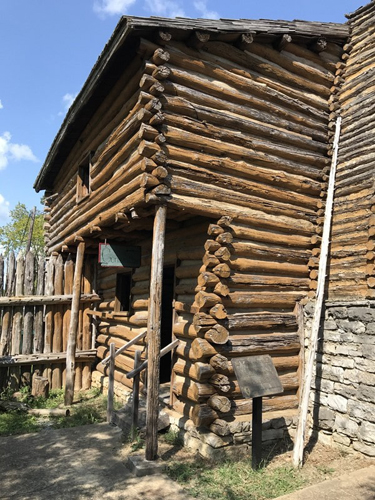
James Harrod, Fort Harrod
On October 1, 2000 the Society of Colonial Wars in the Commonwealth of Kentucky placed its second tablet at Fort Harrod; this one to commemorate James Harrod, founder of the oldest permanent Kentucky town. The settlement, at the headwaters of the Salt River, was known as Harrod’s Town, later to become Harrodsburg. Referred to as the “Birthplace of the West,” Harrodsburg, founded in 1774, was the first and only colonial town west of the Allegheny Mountains.
The tablet relates the early history of Harrodsburg and James Harrod’s role in its founding:
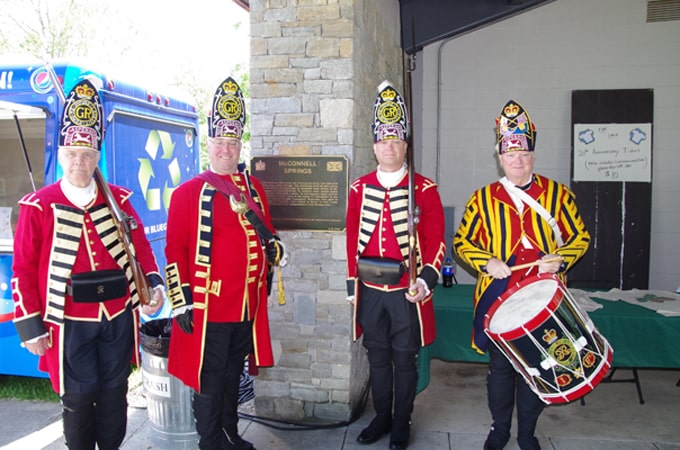
McConnell Springs
The Society of Colonial Wars in the Commonwealth of Kentucky dedicated a tablet at the site of McConnell Springs in Lexington on September 23, 2001. The tablet, which is located at the entrance to the Kentucky American Water Company Education Center at McConnell Springs, commemorates the discovery of the area and the naming of the town of Lexington. In June 1775 William McConnell and his fellow frontier explorers camped at a natural spring in the wilderness of the Virginia territory known as Kentucky. When they learned that the first battle of the American Revolution had been fought in Lexington, Massachusetts, the group named their future settlement in its honor.
During the ensuing years, McConnell Springs, now a National Registered Historic Site, served as the location of a mill, a gunpowder factory, a distillery and a dairy farm. In more recent years, however, the site lay abandoned. In 1993 The Friends of McConnell Springs came together to raise funds and reclaim the site. The site was donated to the Lexington-Fayette Urban County Government to be used as parkland. The Friends cleared hundreds of tons of debris and purchased an adjoining lot on which was built the Kentucky-American Water Company Education Center. The tablet is inscribed with the following narrative:
McConnell Springs is now owned by the Lexington-Fayette Urban County Government and managed by its Division of Parks and Recreation.
On April 25, 2004 the Society of Colonial Wars in the Commonwealth of Kentucky dedicated a tablet, mounted on a large piece of stone, at one end of Royal Spring Park in Georgetown. The tablet tells of the importance of the spring to the history of Georgetown:
In addition to the history contained on the tablet, it is important to note that Royal Spring provided the water that Reverend Elijah Craig used in 1789 to produce the first batch of his new creation…Kentucky Bourbon.